

The Inverted Pyramid
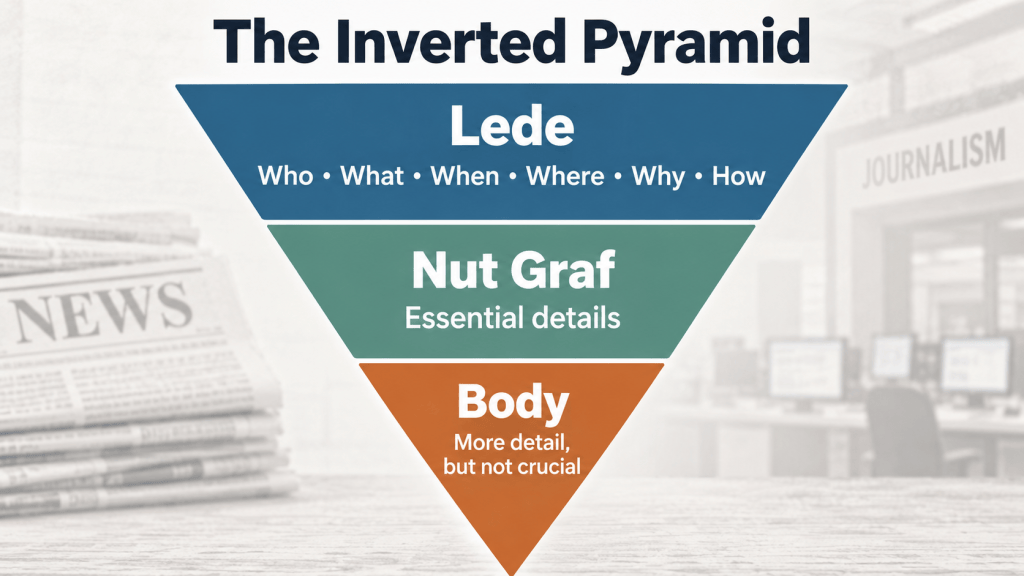
The inverted pyramid organizes information in descending order of importance.
1. The Headline
The headline gets the reader’s attention and tells the reader what the story is about. A headline is not simply a title. Think of it as a mini-lede. It gives the reader an immediate sense of the most important development in the story.
2. The Lede
The lede is the opening sentence of the news story. It gives the reader the most important information immediately by addressing the central questions: Who? What? When? Where? Why? How? Not every one of the six questions must receive equal attention in every lede. The goal is to identify the facts the reader needs first.
A strong lede:
- Is usually one sentence
- Is generally no more than 30 to 35 words
- Gives specific facts
- Tells the reader the most important information in the story
3. The Nut Graf
The nut graf expands on the lede. It provides the essential details needed to understand the story and helps answer an important question for the reader: Why should I care?
The nut graf may explain, clarify, or develop information introduced in the lede. It gives the reader the story in a proverbial nutshell.
The nut graf should continue the inverted-pyramid structure. It should not suddenly turn the story into a chronological narrative.
4. The Body
After the lede and nut graf come additional details.
These may include:
- Supporting facts
- Quotes
- Background
- Context
- Related information
This information still matters, but it is less crucial than what appeared above it. A reader who stops after the lede and nut graf should understand the essential story. A reader who continues gets progressively more detail. That is the inverted pyramid.
Applying the Inverted Pyramid: A Case Study
Consider the following information from a police report.
The Facts
- Time: 2:30 a.m.
- Location: Main Street
- Incident: A car driven by Joe White, 29, hit a curb, crashed into a tree, and overturned.
- Outcome: Amanda Smith, 22, a passenger, was killed.
- Cause: Police say White was speeding and lost control.
- Source: City Police Department
- Quote: “We are conducting toxicology tests to determine if alcohol was involved,” Police Chief Jack Russell said.
A beginning writer might be tempted to tell the story chronologically: Joe White was driving down Main Street at 2:30 a.m. when his car hit a curb…
But that is not the most important fact.
Ask yourself: What happened that makes this news?
A woman died.
That outcome belongs at the top of the pyramid.
Step 1: Identify the Most Important Information
Before writing, rank the facts.
- What: A passenger was killed.
- When: Early today at 2:30 a.m.
- Where: Main Street.
- Why: Police say the driver was speeding and lost control.
- How: The car hit a curb, crashed into a tree, and overturned.
- Source: City Police Department.
Now we can construct the story according to importance rather than chronology.
Step 2: Write the Lede
A 22-year-old passenger was killed early today after a car hit a curb, crashed into a tree and overturned on Main Street.
The sentence gives us the most important outcome immediately.
It also answers several of the basic questions:
- Who: a 22-year-old passenger
- What: was killed
- When: early today
- Where: Main Street
- How: the car hit a curb, crashed into a tree and overturned
Notice what we did not do.
We did not begin with the driver’s name. We did not begin at 2:30 a.m. and narrate each event in order. We began with the fact that matters most.
Step 3: Write the Nut Graf
Now give the reader the essential information that develops the lede: According to the City Police Department, driver Joe White, 29, was speeding when he lost control of the car, killing passenger Amanda Smith, 22.
The nut graf identifies the people involved, provides the suspected cause and attributes the information to police. The reader now understands the essential story.
Step 4: Add Supporting Information
Now we can move farther down the pyramid.
White was hospitalized with minor injuries. “We are conducting toxicology tests to determine if alcohol was involved,” Police Chief Jack Russell said.
This information is relevant. It adds detail and gives the reader more information about the investigation, but the story still makes sense without it. That is why it belongs lower in the pyramid.
Why Use the Inverted Pyramid?
The inverted pyramid serves both the reader and the journalist. Readers can quickly understand the essential facts without reading the entire story. Editors can also shorten a story from the bottom if necessary without removing its most important information.
Think of the structure this way:
- Headline: What is this story about?
- Lede: What happened?
- Nut graf: What else do I need to know, and why does this matter?
- Body: What additional information would help me understand the story better?
The farther down the story you go, the less essential the information becomes.
Inverted Pyramid Checklist
When you write an inverted-pyramid news story, use the following checklist, adapted from journalist Jim Stovall.
Information
Information should be presented in descending order of importance. Do not simply tell events in the order in which they occurred.
Lede
- One sentence
- Generally 30 to 35 words maximum
- Gives specific facts
- Presents the most important information first
Nut Graf
- Expands or develops information introduced in the lede
- Gives the reader essential details and context
- Helps explain why the story matters
- Does not drop the story into chronological narration
Attribution
Major information should be attributed unless it is commonly known or the source is obvious from the information itself. Avoid dumping a string of quotations on the reader. Direct quotations should generally be no more than two sentences long.
Punctuate quotations and attribution correctly:
“John did not go with her,” he said.
The usual sequence is this: quotation + speaker + attribution verb.
AP Style
Check AP style carefully, including:
- Numbers
- Dates
- Locations
- Titles
- Names
Always check names one more time before submitting the story.
Grammar and Mechanics
Check for:
- Pronoun-antecedent agreement
- it / its / it’s
- Correct verb tense
- Comma splices
- Run-on sentences
- Incorrect apostrophes in plurals
Use past tense for completed events rather than present tense or unnecessary past-perfect constructions.
For example, this is a comma splice: He picked up the ball, he ran down the field.
These are two independent clauses and cannot simply be joined with a comma.
Paragraphs
Keep paragraphs short.
In news writing:
- More than three sentences is definitely too long.
- Three sentences is probably too long.
- One- and two-sentence paragraphs are common.
Short paragraphs make news easier to read, especially on screens.
Wordiness
Look for:
- Unnecessary words
- Repetition
- Redundancy
- Information the reader already knows
News writing values clarity and economy.
Names and Titles
When a title appears before a person’s name, do not separate the title from the name with commas.
- Wrong: Game warden, Brad Fisher, arrested the trespassers.
- Right: Game warden Brad Fisher arrested the trespassers.
When the name appears first and the descriptive title follows, set the title off with commas: Brad Fisher, the game warden, arrested the trespassers.
Transitions
Make sure paragraphs connect logically. Do not jump suddenly from one subject to another without helping the reader understand the relationship between the information.
The Big Idea
The inverted pyramid is the foundation of traditional news writing:
- Tell me what happened.
- Tell me what I need to know about it.
- Then give me more detail if I want to keep reading.
Once you understand that structure, you can begin experimenting with other ways of telling journalistic stories. But first, learn to build the pyramid.


Leave a Reply