

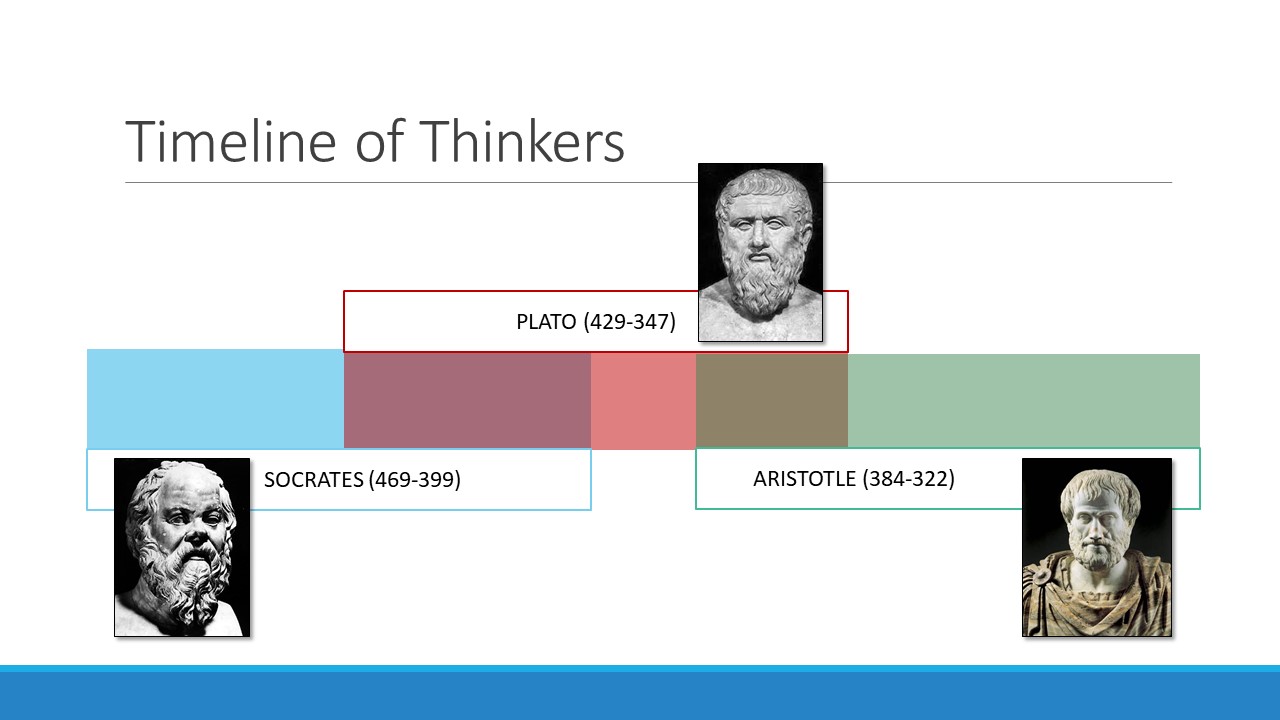
Like Socrates, Plato was a philosopher in ancient Greece, specifically the city-state of Athens. He lived from 429 BC to 347 BC. Plato was a student of Socrates and is one of the primary reasons we even know that Socrates existed. Plato wrote the Socratic Dialogues, a valuable but problematic series of plays in which he used other philosophers as characters. He was a teacher of Aristotle, another revered Greek philosopher, and founder of the Academy at Athens. The Academy—also referred to as The Platonic Academy—was the world’s first university.
The Socratic Dialogues
“They are philosophical discussions … among a small number of interlocutors, many of whom can be identified as real historical figures, and often they begin with a depiction of the setting of the discussion—a visit to a prison, a wealthy man’s house, a celebration over drinks, a religious festival, a visit to the gymnasium, a stroll outside the city’s wall, a long walk on a hot day. As a group, [the dialogues] form vivid portraits of a social world, and are not purely intellectual exchanges between characterless and socially unmarked speakers” (Kraut).
Plato wrote his ideas in an unusual way. Instead of just spelling out his ideas in papers, treatises, publications, or encyclicals like virtually every other philosopher, Plato expressed his thoughts using real and known philosophers as characters. He created dialogues which resembled plays or scripts in which the characters explored and explained philosophical theories and ideas. Socrates was a central character all but one of these dialogues.
Now, this presents a problem for those of us who today are studying both Socrates and Plato. The problem is that there are essentially two kinds of Socratic dialogs. The first are works such as The Apology and Crito, which are generally understood to be the actual words and thoughts of Socrates recorded by Plato. The second are his other works such as Parmenides, Phaedrus, or Republic. In these works, Socrates is a character, but he is just and only that. Plato uses Socrates as a player in the dialogue just as he uses other men: to convey Plato’s own ideas.
Scholars who have delved far more deeply than we shall in this course differentiate the dialogues which capture the actual thoughts and words of Socrates from those who simply employ him as a tool.
The Academy at Athens
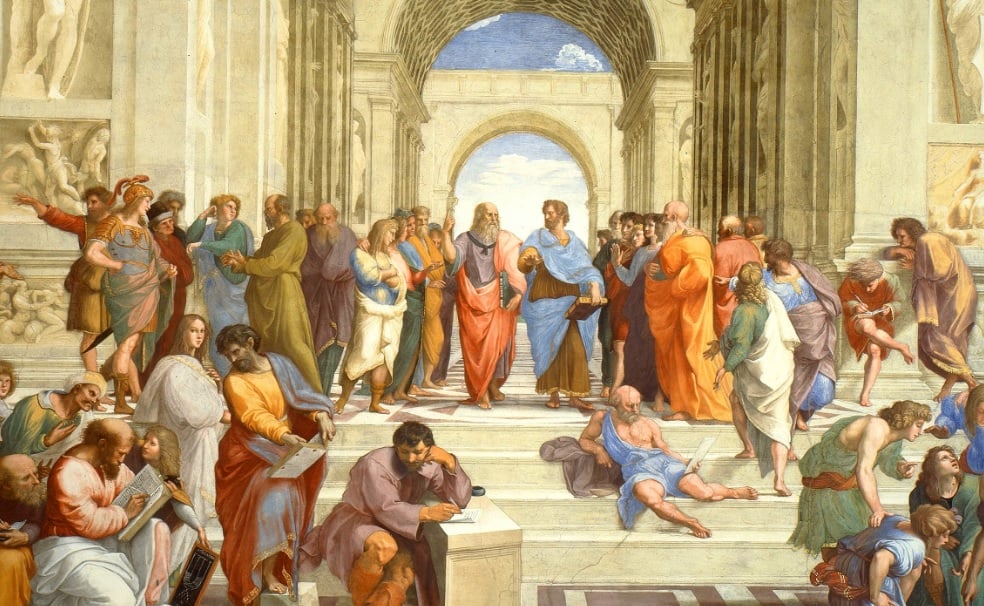
Unlike his teacher Socrates, Plato did not simply wonder the streets engaging people in philosophical dialogue. While he did use dialogue as a teaching method, he taught more formally, using lectures and seminars. Plato created the Academy at Athens in 387 BC. The Academy did not only focus on philosophy. Students and thinkers there explored philosophy, astronomy, mathematics, politics, and physics among other subject matter (Kampouris).
On Democracy
Like Socrates, Plato hated democracy. It has been said that he hated as much as anyone could hate anything. While Plato loathed democratic government for many reasons, we shall examine two major reasons for his disdain. First, in 399 BC, Plato’s mentor and teacher Socrates was democratically voted to be put to death. See The Apology and Socrates.
Second, Plato took issue with the fact that in a democracy anyone—in theory, anyway—could run for and be elected to a leadership position. This did not sit well with Plato as this method of choosing leaders could easily lead to someone uneducated, unintelligent, and unqualified in a position of authority.
Plato’s proposed solution was an interesting one. He proposed what is basically a caste system consisting three classes of citizens: the workers, the police, and the leadership. In Plato’s arrangement, the leaders were to be philosopher kings. He believed only the philosophers were intelligent and capable enough to lead a just society.
Popular Theories
Works Cited
Kampouris, Nick. “The Platonic Academy of Athens: The World’s First University.” The Greek Reporter. greekreporter.com. 9 March 2022.
Kraut, Richard. “Plato.” Stanford Encyclopedia of Philosophy. plato.stanford.edu. 2022.
Plato. The Apology (of Socrates). Trans. Benjamin Jowett. Massachusetts Institute of Technology. classics.mit.edu.
Plato. Crito. Trans. Benjamin Jowett. Massachusetts Institute of Technology. classics.mit.edu. 360 BC.
Raphael. The School at Athens. Vatican Museums, Vatican City. (Public Domain)


Leave a comment